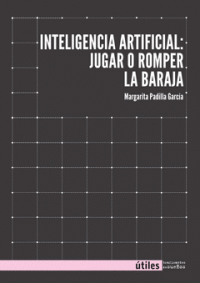
Artificial Intelligence • Play or break the deck

- Media
- book
- Title
- Artificial Intelligence • Play or break the deck
- Author
- Margarita Padilla García
- Review published as
- 148076
- Edited by
- Traficantes de Sueños
As a little disclaimer, I usually review books or articles written in English, and although I will offer this review to Computing Reviews as usual, it is likely it will not be published. The title of this book in Spanish is Inteligencia artificial: jugar o romper la baraja.
I was pointed at this book, published last October by Margarita Padilla García, a well known Free Software activist from Spain who has long worked on analyzing (and shaping) aspects of socio-technological change. As other books published by Traficantes de sueños, this book is published as Open Access, under a CC BY-NC license, and can be downloaded in full. I started casually looking at this book, with too long a backlog of material to read, but soon realized I could just not put it down: it completely captured me.
This book presents several aspects of Artificial Intelligence (AI), written for a general, non-technical audience. Many books with a similar target have been published, but this one is quite unique; first of all, it is written in a personal, non-formal tone. Contrary to what’s usual in my reading, the author made the explicit decision not to fill the book with references to her sources (“because searching on Internet, it’s very easy to find things”), making the book easier to read linearly — a decision I somewhat regret, but recognize helps develop the author’s style.
The book has seven sections, dealing with different aspects of AI. They are the “Visions” (historical framing of the development of AI); “Spectacular” (why do we feel AI to be so disrupting, digging particularly into game engines and search space); “Strategies”, explaining how multilayer neural networks work and linking the various branches of historic AI together, arriving at Natural Language Processing; “On the inside”, tackling technical details such as algorithms, the importance of training data, bias, discrimination; “On the outside”, presenting several example AI implementations with socio-ethical implications; “Philosophy”, presenting the works of Marx, Heidegger and Simondon in their relation with AI, work, justice, ownership; and “Doing”, presenting aspects of social activism in relation to AI. Each part ends with yet another personal note: Margarita Padilla includes a letter to one of her friends related to said part.
Totalling 272 pages (A5, or roughly half-letter, format), this is a rather small book. I read it probably over a week. So, while this book does not provide lots of new information to me, the way how it was written, made it a very pleasing experience, and it will surely influence the way I understand or explain several concepts in this domain.