For the readers of my blog that happen to be in Mexico City, I was invited to give a talk at Instituto de Ciencias Nucleares, Ciudad Universitaria, UNAM.
I will be at Auditorio Marcos Moshinsky, on August 26 starting at 13:00. Auditorio Marcos Moshinsky is where we met for the early (~1996-1997) Mexico Linux User Group meetings. And… Wow. I’m amazed to realize it’s been twenty years that I arrived there, young and innocent, the newest of what looked like a sect obsessed with world domination and a penguin fetish.
Attachments
llavero_chico.png (221 KB)
llavero_orig.png (1678 KB)
Gunnar Wolf - Nice grey life - page 19
Showing posts 181 – 190
Attachments
Presentation (PDF) (12348 KB)
Sources for the presentation (Emacs org-mode v7 ⇒ LaTeX Beamer) (14856 KB)
As I have said here a couple of times already, I am teaching a diploma course on embedded Linux at UNAM, and one of the modules I’m teaching (with Sandino Araico) is the boot process. We focus on ARM for obvious reasons, and while I have done my reading on the topic, I am very far from considering myself an expert. So, after attending Martin Michlmayr’s «Debian on ARM devices» talk, I decided to do its subtitles as part of my teaching job. This talk gives a great panorama on what actually has to happen in order to get an...
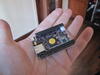
 So cheap we didn’t even have to lie about their value! Went through South African customs unmolested.
I had my strong doubts as to whether the shipment would be allowed through customs, and was happily surprised by a smiling Graham today before noon. He handed me a smallish box that arrived to his office, containing… Our fifty C.H.I.P. computers, those I offered to give away at DebConf! The little machines are quite neat. They are beautiful little devices, including even a plastic back (so you can safely work with it over a conductive surface or things like that). Quite smaller than the usual Raspberry-like format. It has more than enough GPIO to make several of my friends...
Hello world! I’m very happy to inform that the Next Thing Co. has shipped us a pack of 50 C.H.I.P. computers to be given away at DebConf! What is the C.H.I.P.? As their tagline says, it’s the world’s first US$9 computer. Further details: https://nextthing.co/pages/chip All in all, it’s a nice small ARM single-board computer; I won’t bore you on this mail with tons of specs; suffice to say they are probably the most open ARM system I’ve seen to date. So, I agreed with Richard, our contact at the company, I would distribute the machines among the DebConf speakers interested...
Time passes. I had left several (too many?) pending things to be done un the quiet weeks between the end of the lective semestre and the beginning of muy Summer trip to Winter. But Saturday gets closer every moment… And our long trip to the South begins. Among many other things, I wanted to avance with some Debían stuff - both packaging and WRT keyring analysis. I want to contacto some people I left pending interactions with, but honestly, that will only come face to face un Capetown. As to “real life”, I hace too many pending issues at work...
I am submitting a comment to Wen Wen and Chris Forman’s Viewpoint on the Communications of the ACM, titled Economic and business dimensions: Do patent commons and standards-setting organizations help navigate patent thickets?. I believe my comment is worth sharing a bit more openly, so here it goes. Nevertheless, please refer to the original article; it makes very interesting and valid points, and my comment should be taken as an extra note on a great text only! I was very happy to see an article with this viewpoint published. This article, however, mentions some points I believe should be further...
subscribe via RSS